Discussion
Loading...

Post

Log in
  • About
  • Code of conduct
  • Privacy
  • Users
  • Instances
  • About Bonfire
MPI for Gravitational Physics
@mpi_grav@academiccloud.social  ·  activity timestamp 17 hours ago

✨ New selected research highlight ✨

🔎  @einsteinathome's close look at the central compact objects in three supernova remnants.

@maxplanckgesellschaft researchers from the permanent independent research group “Continuous Gravitational Waves” at the @mpi_grav have published results from targeted searches for continuous gravitational waves from three young supernova remnants using public @LIGO data.

The computing power of the volunteer distributed computing project @einsteinathome made this possible.

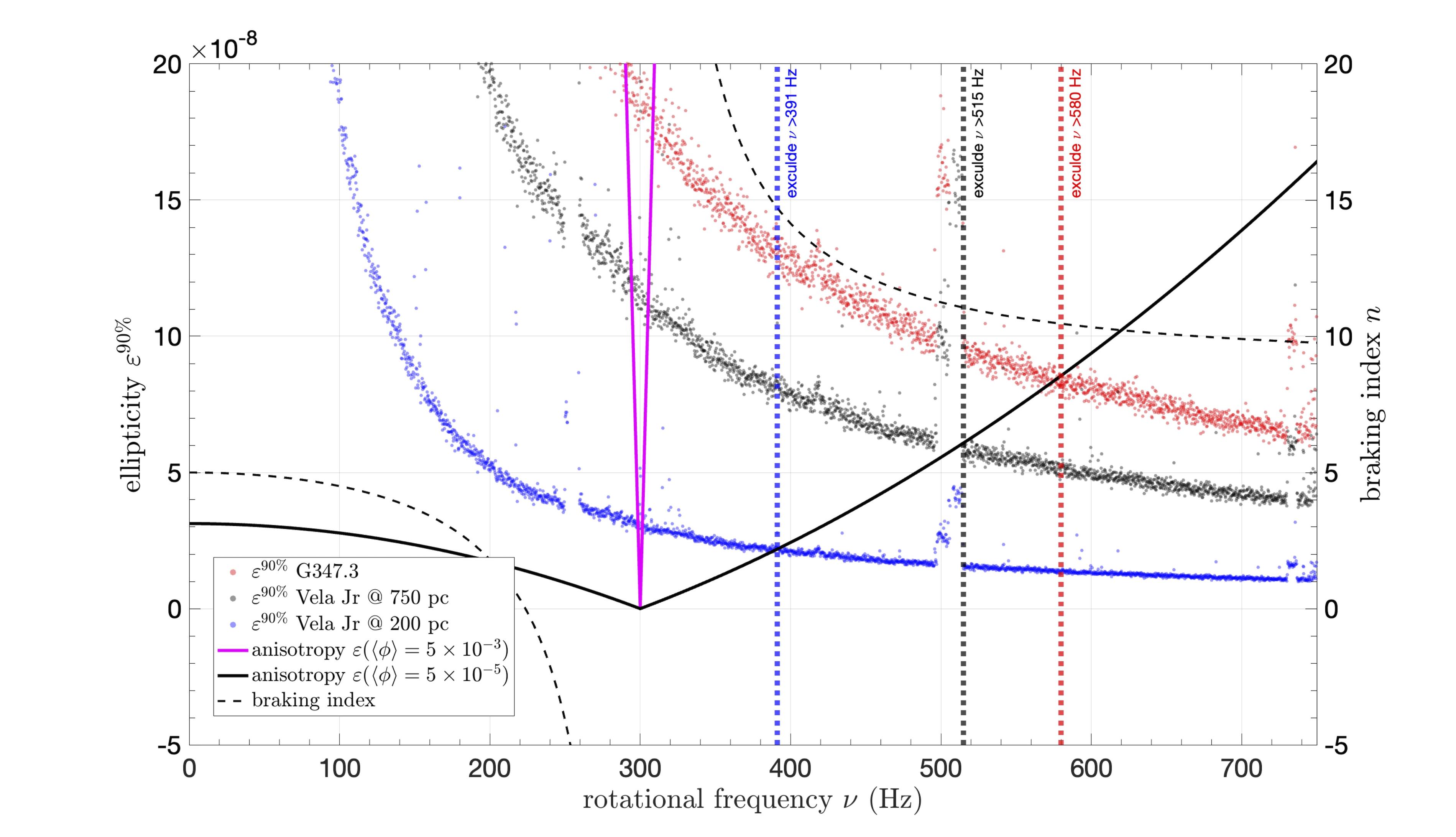
No detection was made and these results provide the most stringent constraints on the ellipticity, r-mode amplitude, and, for the first time ever, crustal anisotropy of the stellar remnants.

One signal candidate remains after follow-up investigations of three independent data sets. Whether it is of astrophysical origin can only be decided by analyzing additional data not yet publicly available.

ℹ️ https://www.aei.mpg.de/1404141/probing-three-supernova-remnants-with-einstein-home
📄 https://arxiv.org/abs/2512.15672

#GravitationalWaves #Astrophysics

Graphs showing ellipticity as a function of rotational frequency.
arXiv.org

Observational constraints on the spin/anisotropy of the CCOs of Cassiopeia A, Vela Jr. and G347.3-0.5 and a single surviving continuous gravitational wave candidate

We carry out the deepest and broadest search for continuous gravitational-wave signals with frequencies between 20-1500 Hz, from three neutron stars at the center of the supernova remnants Cassiopeia A, Vela Jr., and G347.3-0.5. This search was made possible by the computing power shared by thousands of Einstein@Home volunteers. After the initial Einstein@Home search, we perform a multi-stage follow-up of the most promising $\approx$ 45 million signal candidates. In the last stages, we use independent data to further investigate the remaining candidates from the previous stages. We set the most stringent constraints to date on the gravitational-wave amplitude, equatorial ellipticity, r-mode saturation amplitude, and -- for the first time -- the neutron-star crustal anisotropy. For spin periods lower than 2 ms we constrain the ellipticity to be smaller than $4\times 10^{-7}$ for all targets. We exclude the crustal anisotropy to be smaller than $5\times 10^{-3}$ for spin periods between 1.3-100 ms. Only one candidate -- from the low frequency G347.3 search -- survives all follow-ups. We illustrate properties of this candidate. Investigations on new data will aid in clarifying its nature. Such ``new" data exists and would be optimal for this purpose, but they are not publicly accessible at the time of writing.

Probing three supernova remnants with Einstein@Home

Targeted searches reveal stringent constraints on properties of neutron stars in supernova remnants through Einstein@Home's volunteer computing power.
  • Copy link
  • Flag this post
  • Block

Kakapo Social

Kakapo Social: About · Code of conduct · Privacy · Users · Instances
Bonfire social · 1.0.2-alpha.34 no JS en
Automatic federation enabled
Log in
Instance logo
  • Explore
  • About
  • Members
  • Code of Conduct