Discussion
Loading...

#Tag

Log in
  • About
  • Code of conduct
  • Privacy
  • Users
  • Instances
  • About Bonfire
Molli Woodtagger boosted

Lukas VFN 🇪🇺
Lukas VFN 🇪🇺
@animalculum@scholar.social  ·  activity timestamp 4 days ago

A bacterium's built-in compass, explained: Single-cell magnetometry confirms Earth-field alignment https://phys.org/news/2026-02-bacterium-built-compass-cell-magnetometry.html Paper: https://journals.aps.org/pre/abstract/10.1103/lffn-l7m6

"Inside this bacterium is a chain of magnetic nanoparticles. These act like a biological compass and allow the bacterium to align with Earth's magnetic field. In their natural habitat, bodies of water or moist sediments, this compass helps the #bacteria to advance in a systematic manner when searching for the optimal living conditions."
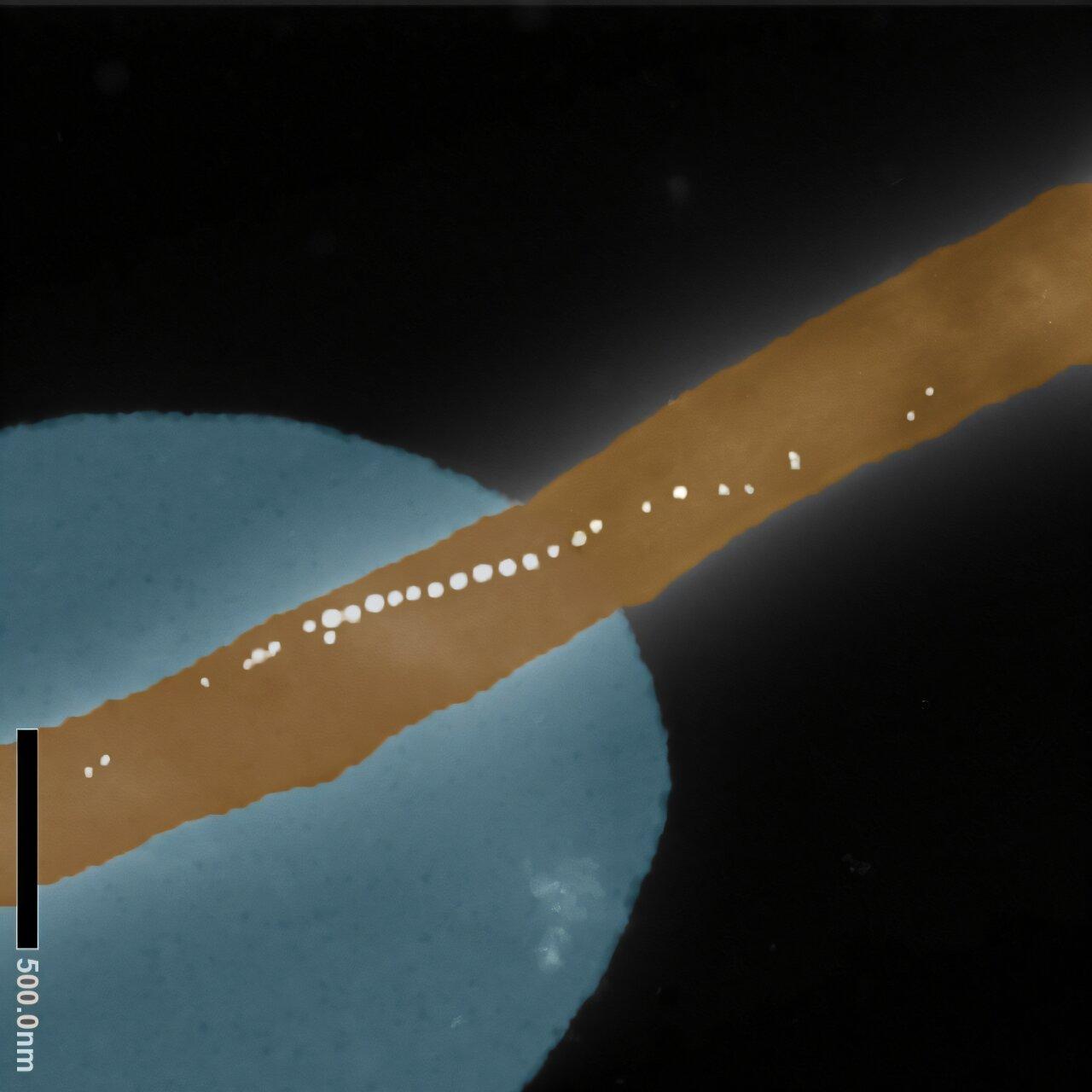
A colorized picture from an electron microscope. The brown elongated shape crossing the image is a rod-shaped bacterium and the smaller white shapes forming a chain inside the bacterium are the magnetic particles the article discusses.

A bacterium's built-in compass, explained: Single-cell magnetometry confirms Earth-field alignment

Some bacterial species possess an astonishing ability: They use Earth's magnetic field to orient themselves. To better understand this mechanism, the team led by Argovia-Professor Martino Poggio from the Swiss Nanoscience Institute and the Department of Physics at the University of Basel took a closer look at the "magnetotactic" bacterium Magnetospirillum gryphiswaldense.
  • Copy link
  • Flag this post
  • Block
Lukas VFN 🇪🇺
Lukas VFN 🇪🇺
@animalculum@scholar.social  ·  activity timestamp 4 days ago

A bacterium's built-in compass, explained: Single-cell magnetometry confirms Earth-field alignment https://phys.org/news/2026-02-bacterium-built-compass-cell-magnetometry.html Paper: https://journals.aps.org/pre/abstract/10.1103/lffn-l7m6

"Inside this bacterium is a chain of magnetic nanoparticles. These act like a biological compass and allow the bacterium to align with Earth's magnetic field. In their natural habitat, bodies of water or moist sediments, this compass helps the #bacteria to advance in a systematic manner when searching for the optimal living conditions."

A colorized picture from an electron microscope. The brown elongated shape crossing the image is a rod-shaped bacterium and the smaller white shapes forming a chain inside the bacterium are the magnetic particles the article discusses.

A bacterium's built-in compass, explained: Single-cell magnetometry confirms Earth-field alignment

Some bacterial species possess an astonishing ability: They use Earth's magnetic field to orient themselves. To better understand this mechanism, the team led by Argovia-Professor Martino Poggio from the Swiss Nanoscience Institute and the Department of Physics at the University of Basel took a closer look at the "magnetotactic" bacterium Magnetospirillum gryphiswaldense.
  • Copy link
  • Flag this post
  • Block
Mensch, Marina boosted
michael
michael
@proseandpassion@mastodon.social  ·  activity timestamp 7 days ago

17-Feb-2026
#Bacteria frozen in ancient underground ice cave found to be resistant against 10 modern #antibiotics
A bacterial strain thriving in icy environments could sharpen antibiotic resistance crisis – or help solve it, new research shows

https://www.eurekalert.org/news-releases/1115156 #science #ecology

EurekAlert!

Bacteria frozen in ancient underground ice cave found to be resistant against 10 modern antibiotics

Bacteria lurk everywhere. However, it’s only after researchers retrieve them from the most remote corners of the Earth that we can learn more about the risks and potentials they pose. When researchers examined a bacterial strain discovered in 5,000-year-old layers of cave ice, they found it resistant to 10 modern antibiotics and harboring even more genes related to resistance. Yet, it also showed promising enzymatic activities and could inhibit the growth of ‘superbugs’ resistant to multiple antibiotics. This highlights the importance of studying ancient bacteria to understand the natural evolution of antibiotic resistance and ways in which those bacteria could be used for future medical and biotechnological solutions, the researchers said.
  • Copy link
  • Flag this post
  • Block
michael
michael
@proseandpassion@mastodon.social  ·  activity timestamp 7 days ago

17-Feb-2026
#Bacteria frozen in ancient underground ice cave found to be resistant against 10 modern #antibiotics
A bacterial strain thriving in icy environments could sharpen antibiotic resistance crisis – or help solve it, new research shows

https://www.eurekalert.org/news-releases/1115156 #science #ecology

EurekAlert!

Bacteria frozen in ancient underground ice cave found to be resistant against 10 modern antibiotics

Bacteria lurk everywhere. However, it’s only after researchers retrieve them from the most remote corners of the Earth that we can learn more about the risks and potentials they pose. When researchers examined a bacterial strain discovered in 5,000-year-old layers of cave ice, they found it resistant to 10 modern antibiotics and harboring even more genes related to resistance. Yet, it also showed promising enzymatic activities and could inhibit the growth of ‘superbugs’ resistant to multiple antibiotics. This highlights the importance of studying ancient bacteria to understand the natural evolution of antibiotic resistance and ways in which those bacteria could be used for future medical and biotechnological solutions, the researchers said.
  • Copy link
  • Flag this post
  • Block

Kakapo Social

Kakapo Social: About · Code of conduct · Privacy · Users · Instances
Bonfire social · 1.0.2-alpha.34 no JS en
Automatic federation enabled
Log in
Instance logo
  • Explore
  • About
  • Members
  • Code of Conduct