
Two views of Jupiter through my telescope last night, taken a few hours before its closest approach to Earth (393.3 million miles/632.9 million km). I was excited to see all four Galilean moons (Ganymede, Callisto, Io, and Europa) around it as well. Not the clearest images as I don’t have the best gear or viewing conditions in light-polluted Brooklyn, but they’re better than my first attempts, and I’ll keep trying to improve.
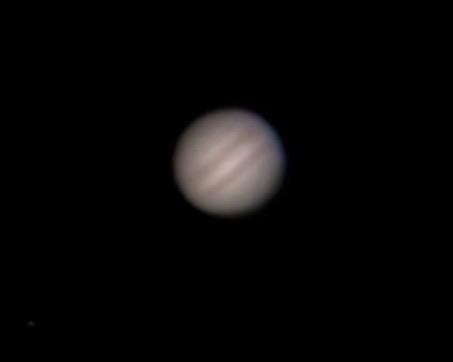
Jupiter against a black sky. Image has been enlarged and exposure dimmed to show its cloud bands — particularly two dark streaks near its equator, oriented diagonally from lower left to upper right.
Photographed with an iPhone 15 attached to a Celestron 130mm reflector telescope with a 25mm eyepiece and 2x Barlow lens. Edited in Snapseed.
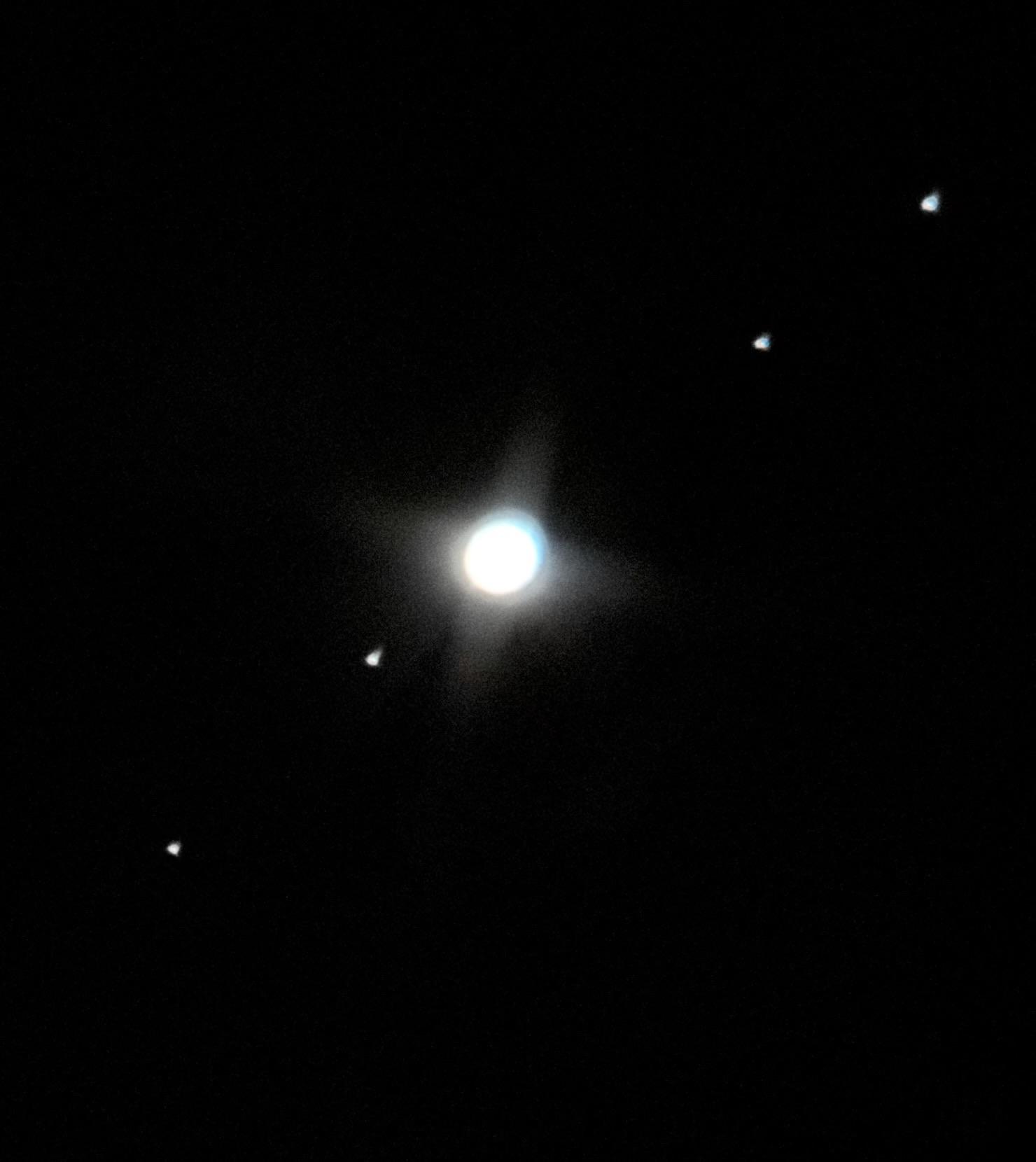
Jupiter flanked by its Galilean moons — Ganymede, Callisto, Io, and Europa, the four largest of its 97 moons — against a black sky. They appear in a diagonal row from the lower left to the upper right of the image, with Jupiter as a bright disk in the center with two points of light on either side. The planet displays a luminous starburst effect, caused by diffraction spikes due to the telescope’s structure.
Photographed with an iPhone 15 attached to a Celestron 130mm reflector telescope with a 25mm eyepiece and 2x Barlow lens.